
PASTE TABLE GALLERY : Nick Cash
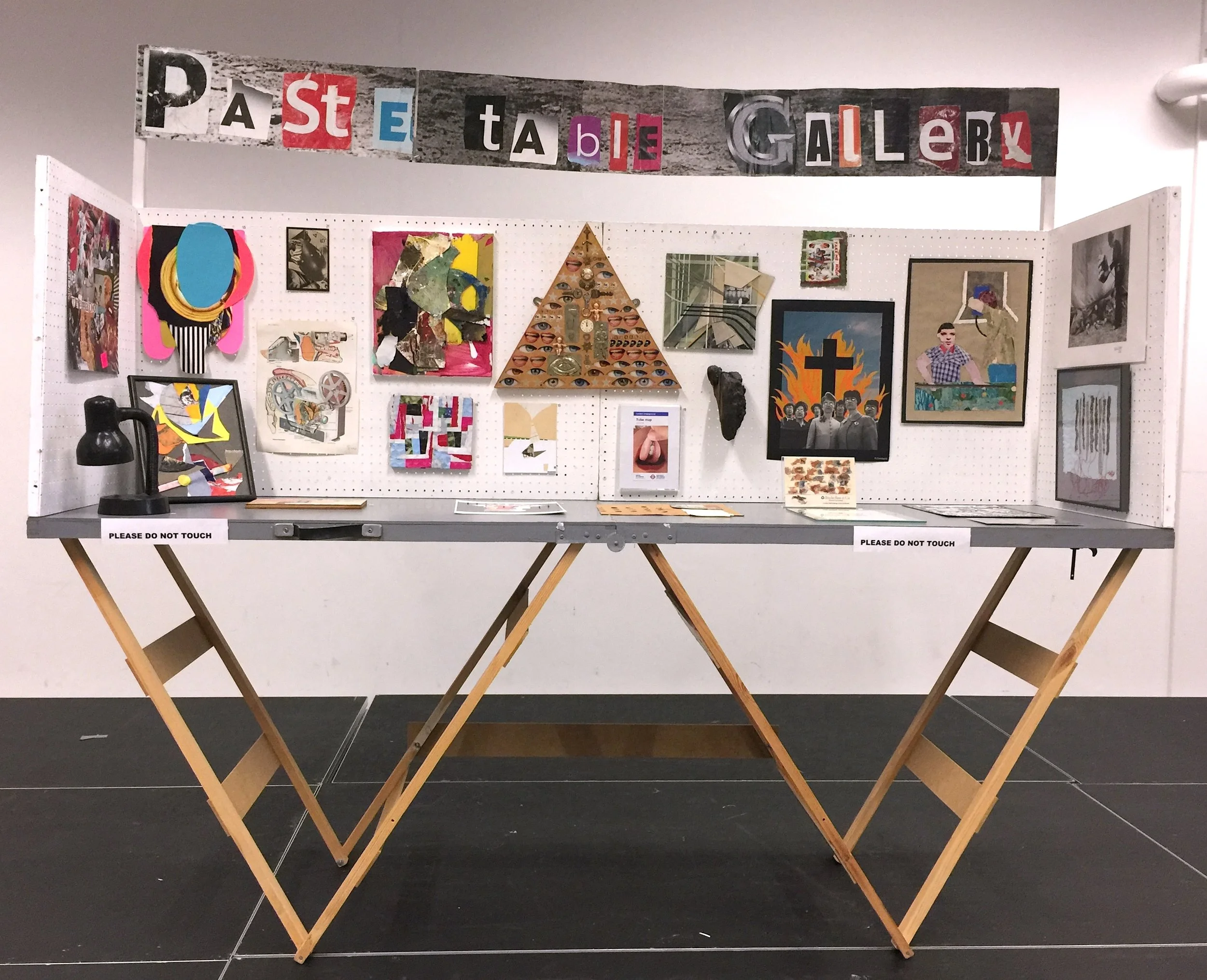
I started Paste Table Gallery in 2012 as I saw a need for a gallery specialising in cut and paste. There did not appear to be such a gallery. I did not have the resources to open a fixed space with all the attending costs and commitment of time needed to run a permanent venue. I have been a habitué of boot fairs for many years and so the idea of a portable set up was appealing. The pasting table was an obvious choice it folds neatly and can be stored easily. Then the notion of a mini white cube came to me, hence the white pegboard walls and the table painted in a typical gallery grey.
The Paste Table was a way of presenting my own work and then other artists I would meet, or actively seek out on the world wide web. Some were also recommended by curators, notably John Bunker, brought to my attention by Rosella Black at Westminster Reference Library. The initial idea was that the table would be portable enough to carry on a trolley and could be moved around on public transport, however the table and walls, collage work, and associated tools and materials made that difficult.
I am personally only interested in analogue collage, the imperfections, topography and hand of the artist can be seen in analogue pieces where digital flattens or hides. I have eschewed digital collage though it could be shown via a mini projector and I would not rule that out.
Artists that are invited to show on the table are gathered from around the globe, putting together those who are well known, the emerging or pupating, together with complete amateurs. Amateur, in its purest sense for the love of something as opposed to cynical careerism. Ignoring the usual hierarchical concerns of the white cubes and media. The classification of art workers as professional, schooled or ‘outsider’ is anathema to PTG the only criteria for including the work apart from being collage is, it excites, intrigues, disturbs or says something.
An interesting thing about the collage fraternity is the willingness to collaborate personally and collectively. A collagist makes a starter work and then passes it on for someone who could be unknown to them and in another country to finish. A group of like-minded artists come together
as a collective to show collage and make work together in a workshop setting. This goes on to some degree in the rest of the art world but not to the same extent. Virtually every City has at least one collage club/collective something which is much rarer in other areas of art making which tend to be more individualistic. In the world of collage there is a generosity of spirit and willingness to share information, resources and physical help. I have not fully analysed why this is the case and would be interested to know if others feel this to be the case.
Collage is one of the most democratic mediums, with access to tools and materials available to most people. Using stuff from discarded books magazines and other detritus, narrative or structure can be achieved very quickly. Only a small space is required to make work leading to a plethora of collage out in the world. It is possible to be overwhelmed by the amount of material on the Super Information Highway. There is a lot out there that could be seen as generic or formulaic. Maybe a taxonomy of collage needs to be developed with various genres of image process aligned to one branch or another.
A mission of Paste Table Gallery is to find the seeds amongst the chaff, to discover the most interesting new collage and show it along with historical pieces when they present themselves.
The exhibitions do not usually have a thematic structure other than the work is all collage, un-collage, assemblage. I choose work that appeals to me on its own terms. It might simply be an aesthetic or messthetic that cannot be ignored, or it could be an interest in the artist’s intent to create a narrative. I am not concerned with creating a structure that the art has to fit into, that would be spurious. I expect that some links, connections and battles will happen between the works when they are hung. I am interested in the difference between pieces, some tightly controlled and exquisitely made, balanced by something that is loose, and open to exploration.
Chance is an important factor in my own work, prescribing things too much stops conversation and investigation. Chance is also a factor in how the artists are found, from searching the internet to meeting someone through one of the exhibitions.
Collage is sometimes seen as inferior to other art making perhaps because it can be quick to make or it's something that children do at school or seemingly requires little skill. I think it s important to turn those problems around and embrace them in a positive light. All art making is about decision making even if it is at a sub conscious level, risks must be taken and a commitment made to materials, process and structure. The collage in PTG shows that it can be delicate, refined and detailed on
the one hand but it can also be loose and messy allowing an aleatoric methodology to rule. A life and reality can be gleaned from the detritus and materials collated and stuck together.
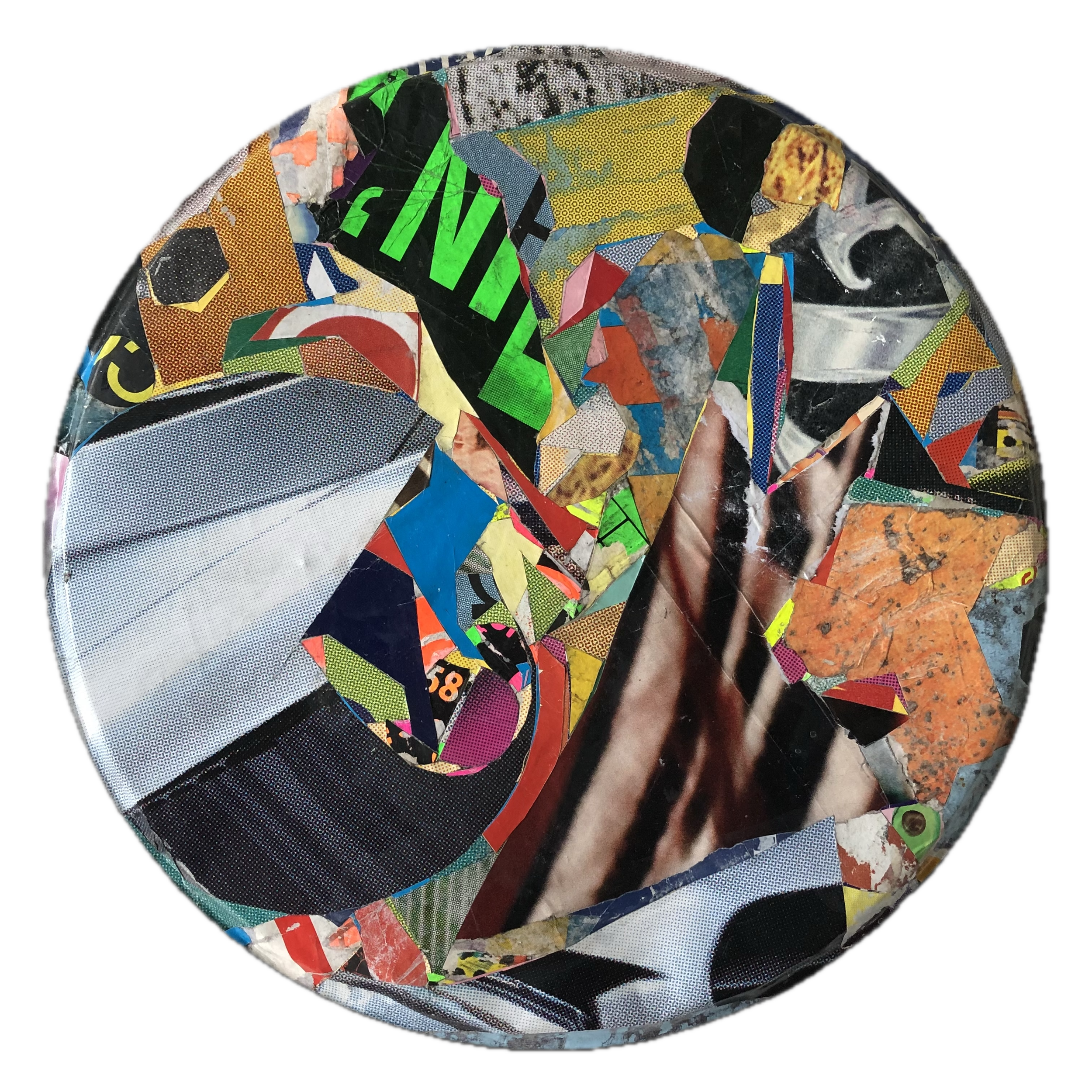
You can see more of Nick’s work on his Instagram account : @ca3hin and @paste_table_gallery_collage
Enjoying the CC. Blog? Support us for as little as £1 per month