
Jodi Hays
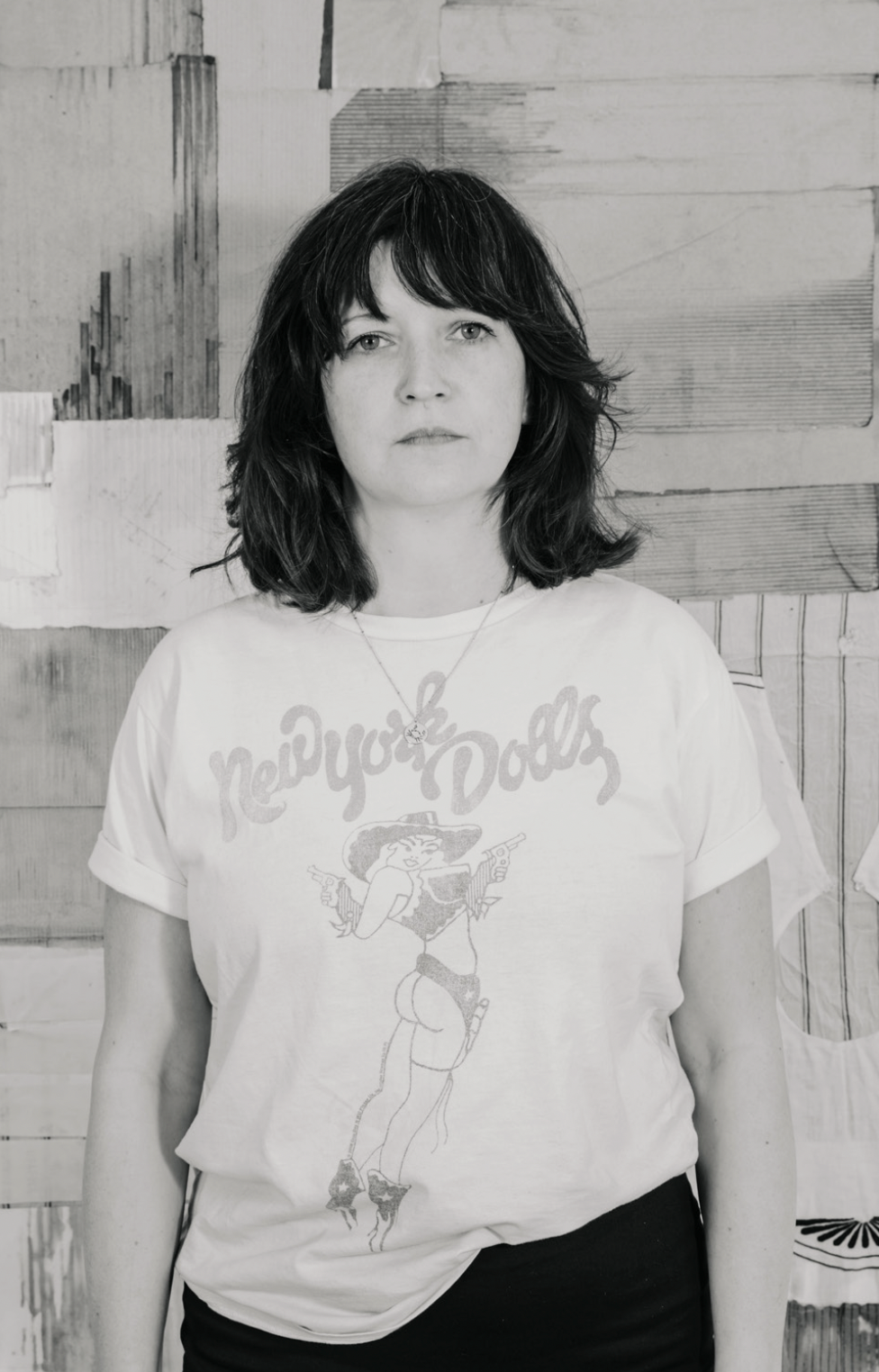
Jodi Hays was born and raised in the American South. Her large-scale collage assemblages are inspired by the deep south and created using reclaimed textiles, fabric and cardboard. She says that she paints as ‘a form of note-taking and organising knowledge’ – we thought we'd gain a little of that knowledge ourselves by talking to Jodi in her studio in Nashville, Tennessee.
Hi Jodi, you’ve recently had an exhibition, can you tell us a bit about that?
It was a solo show of my most recent paintings at Night Gallery in Los Angeles. I call them paintings because I like to start a conversation around how we define what a painting is – what materials make up a collage or a painting or an assemblage. The pieces are all mounted on strainers, and there were six in the exhibition, which closed at the end of July.
I was interested in the description of yourself that you have on your Instagram page, it says ‘Painter. Mystic. Lover. Fighter’, I was wondering why those specific words?
Painter: I’m a painter first, that’s the condition through which I see the world.
Mystic: I find that I’m interested in material and also immaterial things, so mystic encapsulates that. Painter is the material and mystic is the immaterial.
Lover: I’m a Cancer – I’m deeply feeling.
Fighter: My favourite poet C.D Wright paraphrased Arkansans 1930s WPA (Works Project Administration) Guide to Arkansas that said...‘Arkansans can’t sing, don’t smile, won’t fight unless prompted and then until death.’
I get an immediate sense when reading some bits from your website and from looking at your work, that the landscape and environment of the South feeds a lot into your work.
Absolutely. There are lots of artists here in the middle of the country that are making work embedded in a particularly southern vernacular.
Looking at your work, you seem to be sourcing your materials from your environment as well?
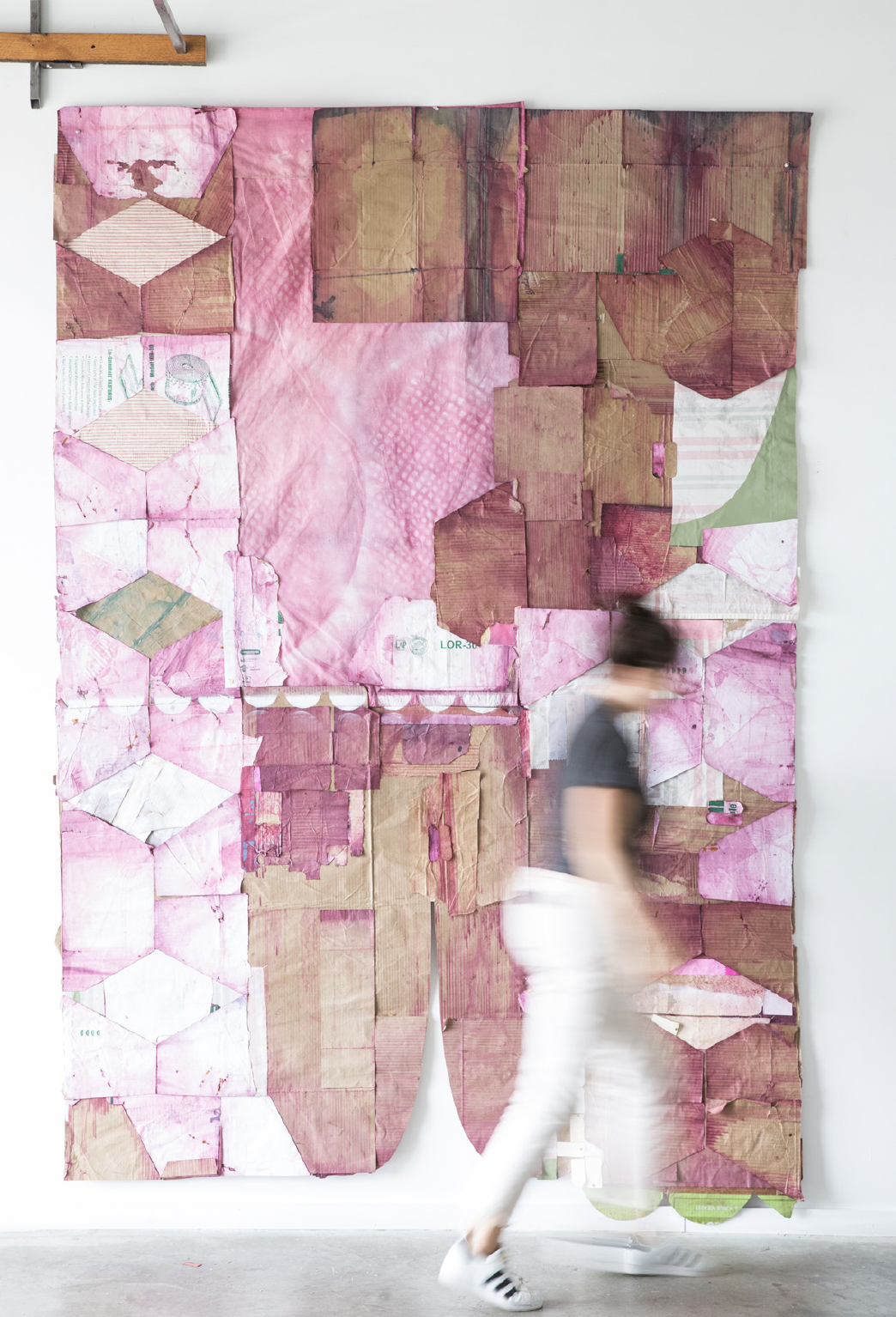
I come from a background of European painting—its architecture, so that’s kind of where the materials tell that story. A lot of the materials are sourced from my alley, or boxes. Some are new materials, fabric and canvas, and some aren’t. Some are vintage dish towels and things that I source on eBay.
What led me to these materials and to a departure from more traditional painting mediums, was that I was reliant on grids and stripes, and I started following stripes that are found in patterns and textiles. I started sewing and piecing those together, then it wasn’t too big a jump to use papers to attach to those fabrics and all the canvases that I had started. That meant that they were suddenly collages, because I was gluing to fix them together as opposed to sewing them like you would in a canvas.
From your perspective, is there a narrative that you want to come through from those pieces?
No. What I’d hope the very loose narrative to be, is that the architecture of painting is big enough to allow for new tellings of what painting can do.
The landscape and trees are reference points in terms of things that might be representational then if you like? I’m just wondering if there’s an underlying emotive element to your work as well?
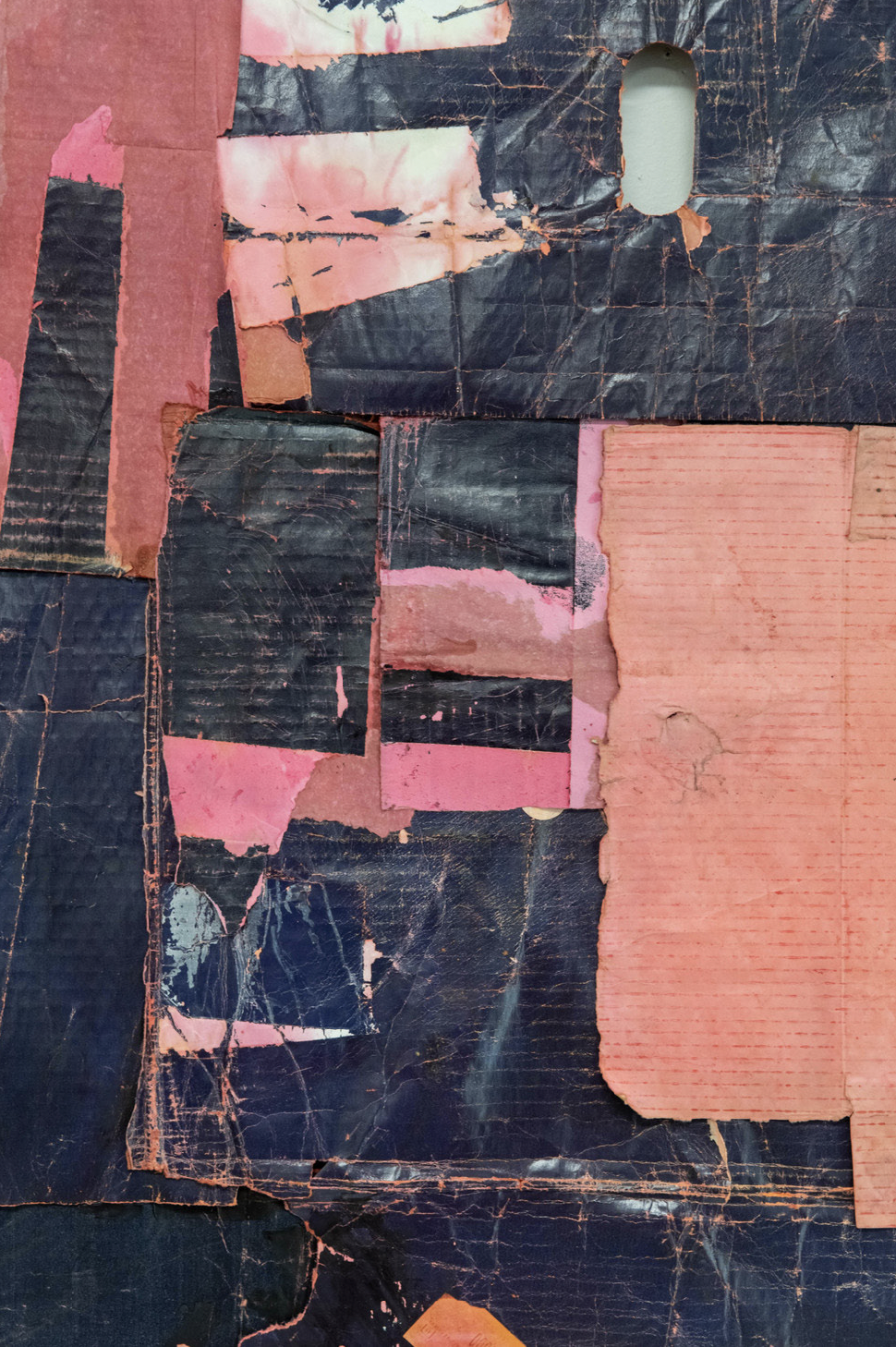
I think the emotive content comes from the materiality of the pieces. Either because it looks like an older material or because of an association the viewer might have with it, or just the piecing together of work. They’re very heavy and dense, they refer to minimalism in some ways and maximalism in others. I think the emotive content comes from the materiality of the works, not an overt story.
My pieces feel like quilt tops, I’m looking at one in my studio now. In years past, I’ve stretched my work around a panel. But now, I want these pieces to be more breathable. I want the back read to be accessible whether that be for a gallery goer, a collector or a museum, to lay bare where the story comes from. I want the materials to be exactly what they are, unhidden.
I was going to touch upon that quilted aspect of your work, of course, you’ve got the Gee’s Bend quiltmakers in the South too.
Yes, they’re in Alabama which is about seven or eight hours from here. Gee’s Bend is brilliant and I’m definitely picking up on, not only that geographical story, but that gendered story of what women were allowed to do and the handy work that we were assigned to. Rosie Lee Tomkins is a native Arkansan, BAMPFA showed her posthumous retrospective in 2020.
Thinking about Gee’s Bend, that also picks up on one of your influences, the Art Povera – art based on the materials that are readily available or recycled in some way, which is exactly what the Gee’s Bend women were doing with those old quilts - using old jeans and clothes to cut up. That comes up in your work as well, in terms of the recycling of materials.
Absolutely. A lot of my family were country farmers. My great-grandparents and grandparents were migrant workers, so the idea is that you ‘make do’ – it’s a southern phrase to get by with what you have around. I call it a southern Povera because it’s a slant from the Italian movement, Art Povera.
Also the Black Mountain College material studies that Josef and Annie Albers bought over from the Bauhaus have been really influential to just see what you can do. That college was so strapped for money, so they were making art with nothing.
Yes, I think Rauschenberg said something like, ‘everything you need to make art is within two blocks of where you live’.
Changing tack for a moment, I want to ask you about the titling of your work. I was looking at some of your previous pieces and I was trying to make the connection between the work and the title. Is that something you have in mind while you’re working or is it a question of finishing the work and seeing what it’s saying to you?
I usually have titles before, I don’t have prescriptive notions with what kind of work will go with that title, but I keep an extensive list. Sometimes I’ll reclaim and recycle my own titles. If I made a painting twenty years ago that had a great title but it was a mediocre painting, I’ll reuse it.
My title rules are generally that they have to be somehow relevant in some way to the world of painting. So it can comment on that history, often for large scale work I’ll use really big titles such as ‘Pieta’ or ‘Deposition’, then I’m using these humble materials to speak to that art world convention. Then the titles have to be personally relevant or have something in me that I'd like to put in there.
I started in college with a group students who made figurative work, then finished undergrad trained by abstract and mainly conceptual painters at University of Tennesse, with fellow student, Josh Smith. It took me years to figure out how to marry those genres that were presented to me as disparate. It took me getting older and making for twenty years to realise that they weren’t exclusive, that you could do all of that.
I see my titles as devices that can give the viewer a toe-hold into the piece. I can present you with an abstraction, but I can give you a title that gives you something that allows an entrance to the piece. I feel like titles expand the pieces out, they don’t limit. If I’m doing it right in my world, then you’re able to enter into it and find your own story within the piece.
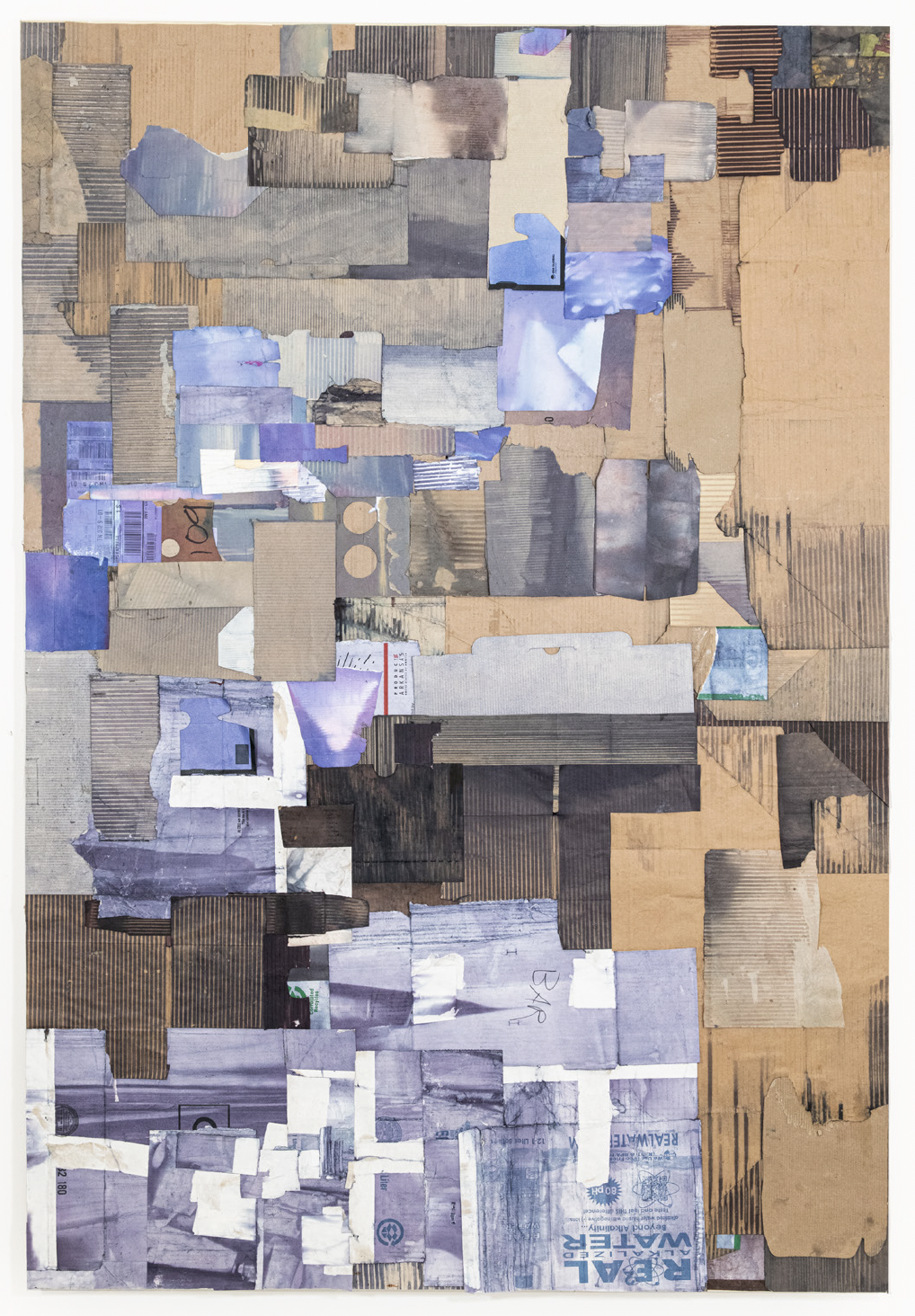
Above : Deposition (Blues)
It’s strange isn’t it that you can look at the image itself but as soon as you read the title you start to see it in a different way.
I’m not a quilter, I don’t sew well. My Mom does and my family did, but I use quilt titles. I’m kind of asserting myself in that history by using those conventions to name my work. ‘Steps to the altar’ is one, they’re so rich and whacky.
You mentioned a couple of times, the architecture of painting and I just wanted to expand on that a little bit. When I look at your work I get this real sense of you building each piece. The fact that you’re using a grid system quite a lot, there seems to be a sense of architecture and structure within your work, like you’re physically building the images, is that an accurate description? Do you see them as structures?
I see paintings as objects with structure, yes. How do you make a painting? You make it with wood, with paint, with size, with a support. So how do you work and play with the rules of painting but also push them to something further? I’d like to think I do that with material.
My dad owned a building supply company growing up, so I think I come at seeing the world through architecture really honestly -through materiality, piles of lumber, trucks full of logs and feed sacks.
There’s an architectural school called Rural Studio out of Auburn University, also in Alabama. The Rural Studio was started by Samual Mockbee but it’s a school where they would make homes for people in the surrounding county out of experimental and reclaimed materials. Had I known that the Rural Studio existed when I went to college, perhaps that would have been something I would have pursued.
Do you ever get that sense of art that’s good for the environment? In that you’re taking those materials and they’re not going to landfill, they’re being used for something that’s quite beautiful.
I’m aware of that narrative in the work, particularly coming out of the pandemic and everything that we had shipped to us. The environmental lens is not the foot I lead with, though obviously, it is a concern outside of the studio. For my work, I’m more interested in the ways that these materials relate to the world of painting.
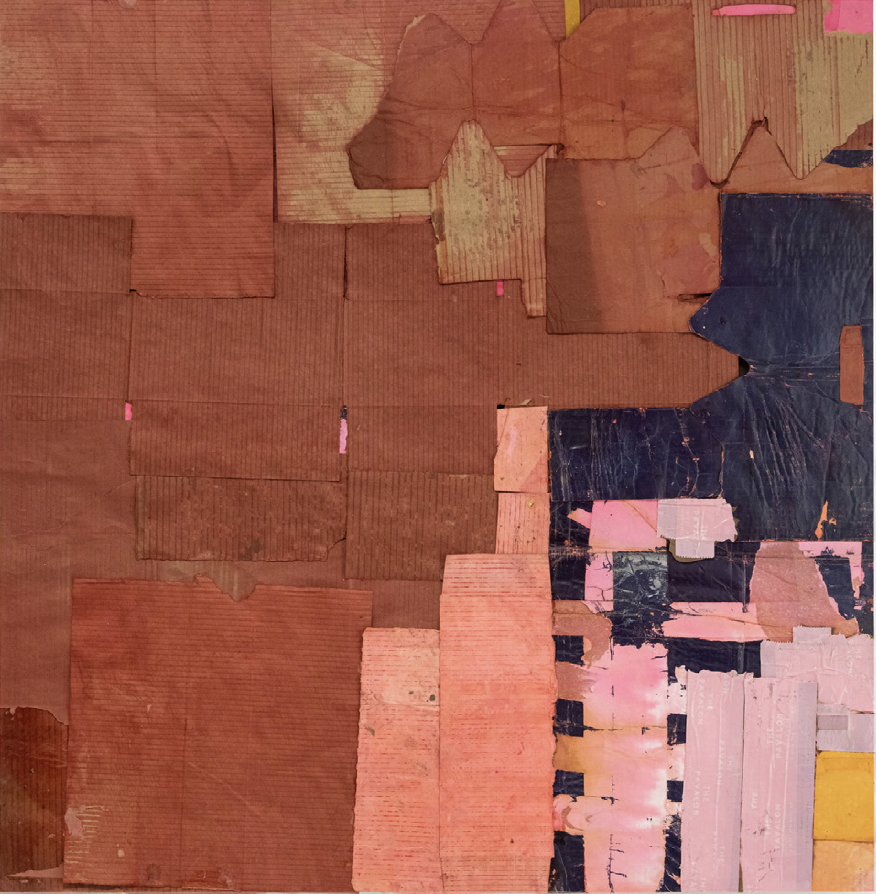
Above : Rosy
I wanted to ask you about your process – where you start when you begin to pull an image together. Are you painting over bits of those found materials, are you doing that in situ or is it a separate process?
I was making work really small a few years ago, but then they just started expanding to bigger and bigger works. I usually piece the work out on the floor and then glue it together. I dye the pieces, dry them under big Masonite boards to keep them flat. There’s so much visual and textural information just in one little bit of cardboard. My job when I’m making a painting is to either unify that or create a singular prompt or something out of those disparate parts, like a shotgun wedding.
You can see more of Jodi's work on her website: jodihays.com and on her Instagram page: @jodihayspainter