Barbara Breitenfellner

Barbara Breitenfellner is a German-Austrian artist living in Berlin. Over the past twenty-five years, she has established a hugely successful duel-focused practice. Working with museums and art institutions, she builds large-scale installations based on her dream diary and, as a counterpoint to that work, she uses her studio to produce collages and prints. We met Barbara in Berlin to talk about her fascinating world.
Below article first published in Issue #22 of CC. Magazine, July 2023
Hi Barbara, when did you first get into collage?
At art school I focused on sculpture, then installation and performance. I obtained my Master of Fine Arts degree at the Glasgow School of Art where I worked on my first pieces related to dreams. I participated in residencies in Copenhagen and the USA, and I also lived in France for a while. Then I moved to Berlin in 2002 and started creating large installations.
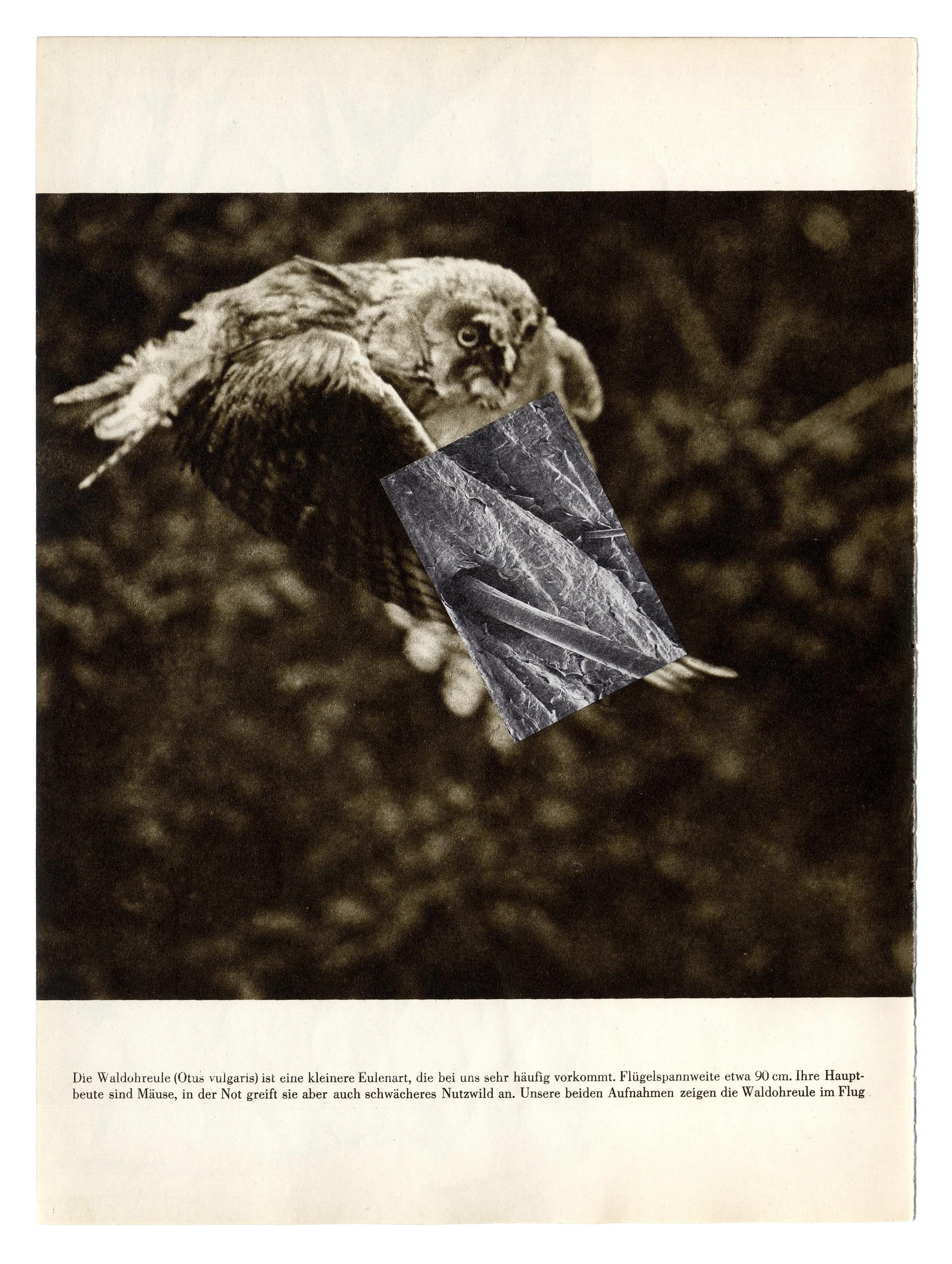
I made my first collage in Florida in 2008. I attended a residency at the Atlantic Centre for the Arts, invited by Mark Dion. He chose artists to spend time with him, discussing and sharing experiences and practices around the notion of nature. I just had a few books with me and, between conversations and a visit to Disneyland, I took a rectangular piece of a microscopic photo of body hair and it ended up on the wing of a flying owl. The motifs matched almost perfectly. It looked a bit like
a strange X-ray shot. It was quite a simple gesture that made clear to me that collages are an immediate and direct way of expressing myself. But I would always say that the installations are collages set in space and the collages are installations in two dimensions.
How do you normally start a piece?
I usually begin with a background. I’ll take a book apart, keeping ten to twenty pages and discard the rest. I can spend hours looking for the elements fitting that background and if there’s something interesting happening, I’ll use paper-clips to temporarily assemble bits and fragments together, and I’ll hang it in my studio. I’ll study it and decide if it’s something that goes somewhere. If I’m not convinced after several days, I’ll dismantle it and start again from scratch. I always work on several collages at the same time.
Obviously, there are often some accidents that interfere with the making of a piece. These mishaps sometimes become methods. One
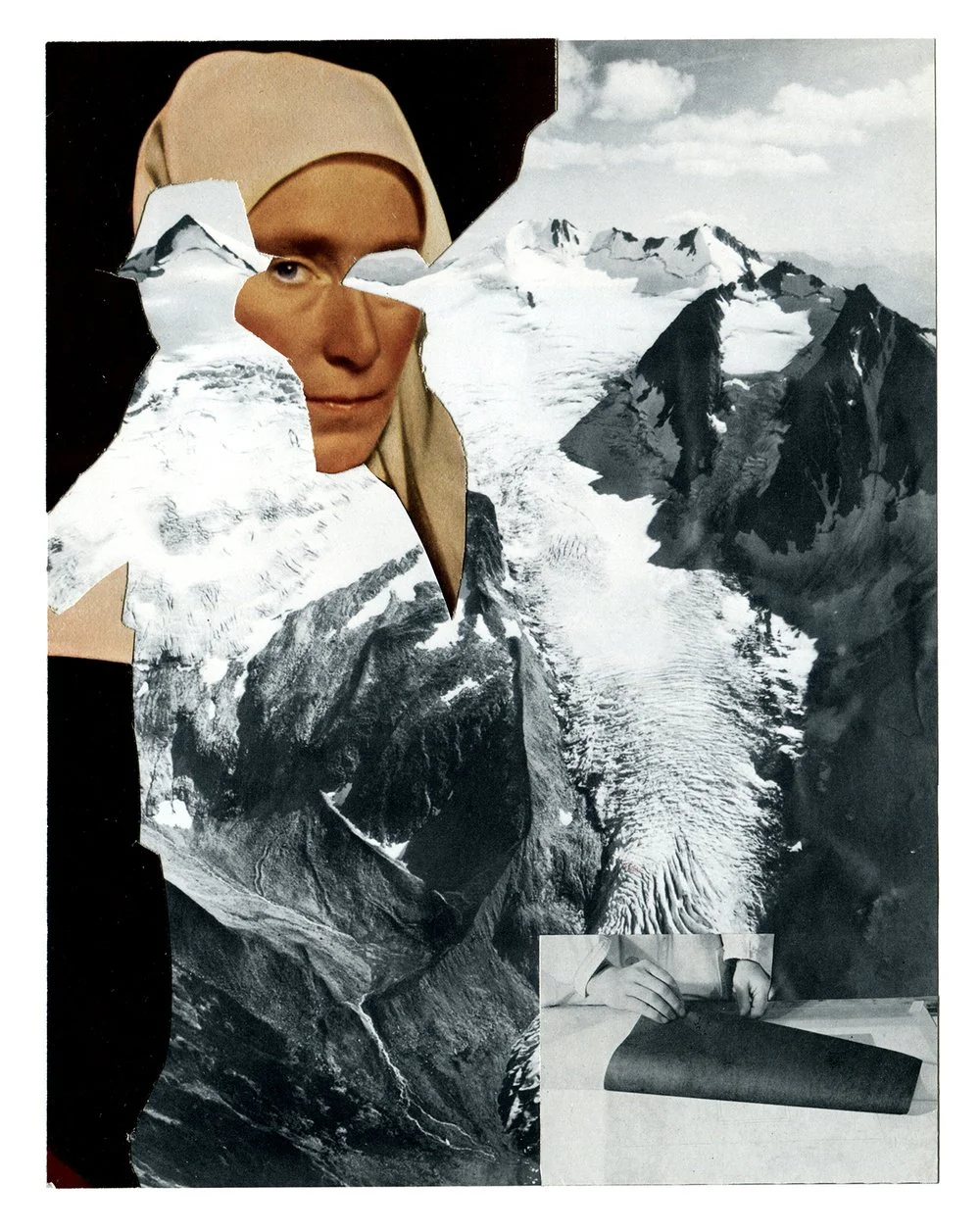
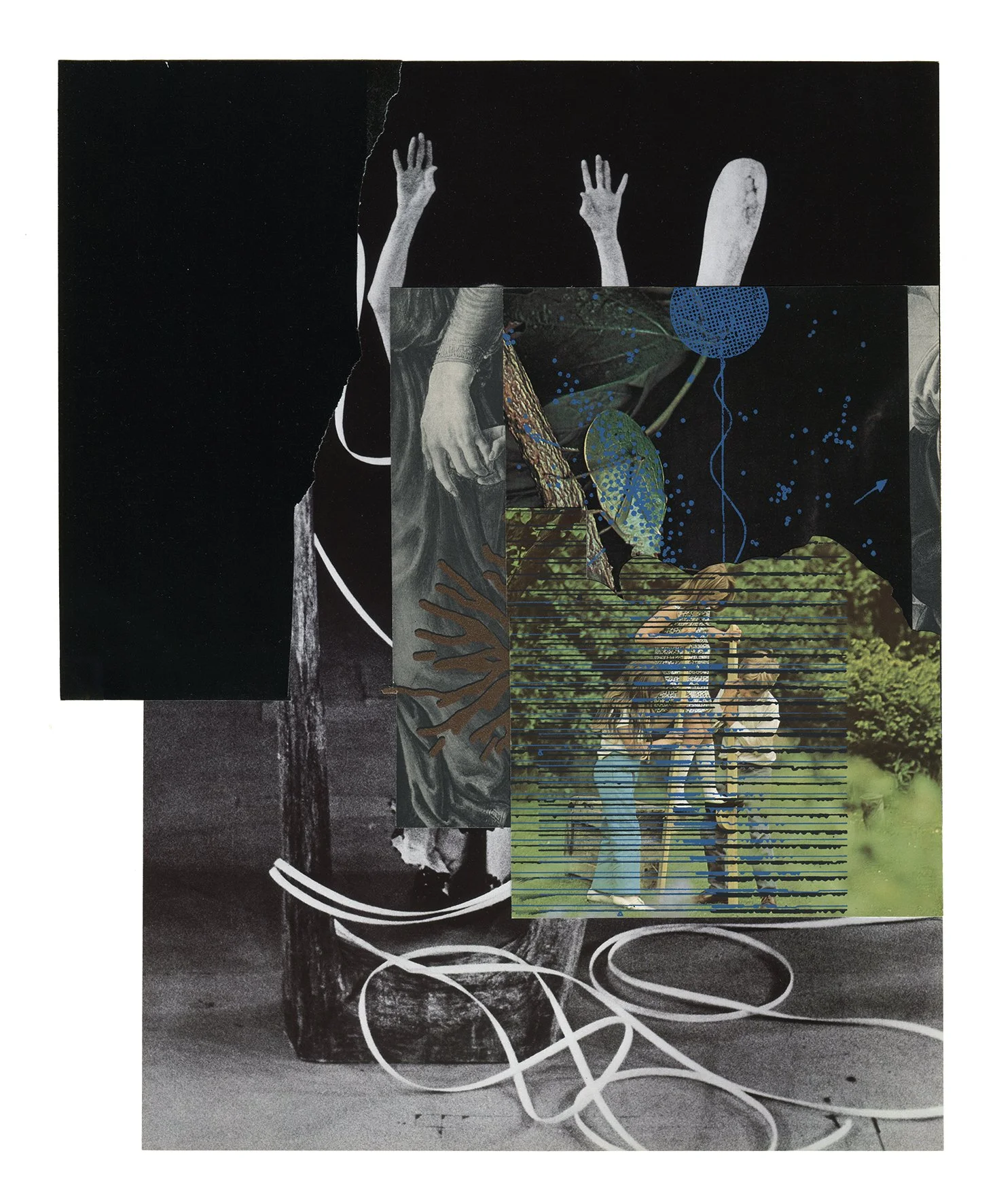
of my favourite tricks is to flip a snippet to reveal its other side. I enjoy those cuts that are going against the perception of the image, the unplanned meeting of a shape and a motive. That is a technique I use a lot.
After hours of moving the materials around, I decide whether the collage is finished. Then I glue and scan the composition and it goes into the data bank. I don’t give titles to my collages, so I have to keep a comprehensive catalogue raisonné with each of my works numbered to track where the pieces are, because I’m publishing, selling and exhibiting a lot these days. I have recently produced my 727th collage, and I’m still not bored making them.
That seems to involve a lot of preparation in terms of the shapes you cut out. I envisage that you spend a few hours where you cut, screen-print or make marks on images and then put them in the bank, so to speak.
Yes. Although I wouldn’t just spend hours randomly cutting paper. I think the best preparation for making a good collage lies in the books you buy. That’s the most interesting moment.
Is the searching for materials an enjoyable part of the process for you?
I love it. I go to second-hand bookshops and flea markets, but I also find many books given for free in the streets of Berlin. I also sometimes buy several copies of the same publication. Often, for my birthday, friends bring me books to cut and I realise how well they know me and how much they appreciate what I do. Because they see the potential in some images, they can foresee how the books could trigger my imagination.
Do you ever have any anxiety or fears about taking a whole book apart?
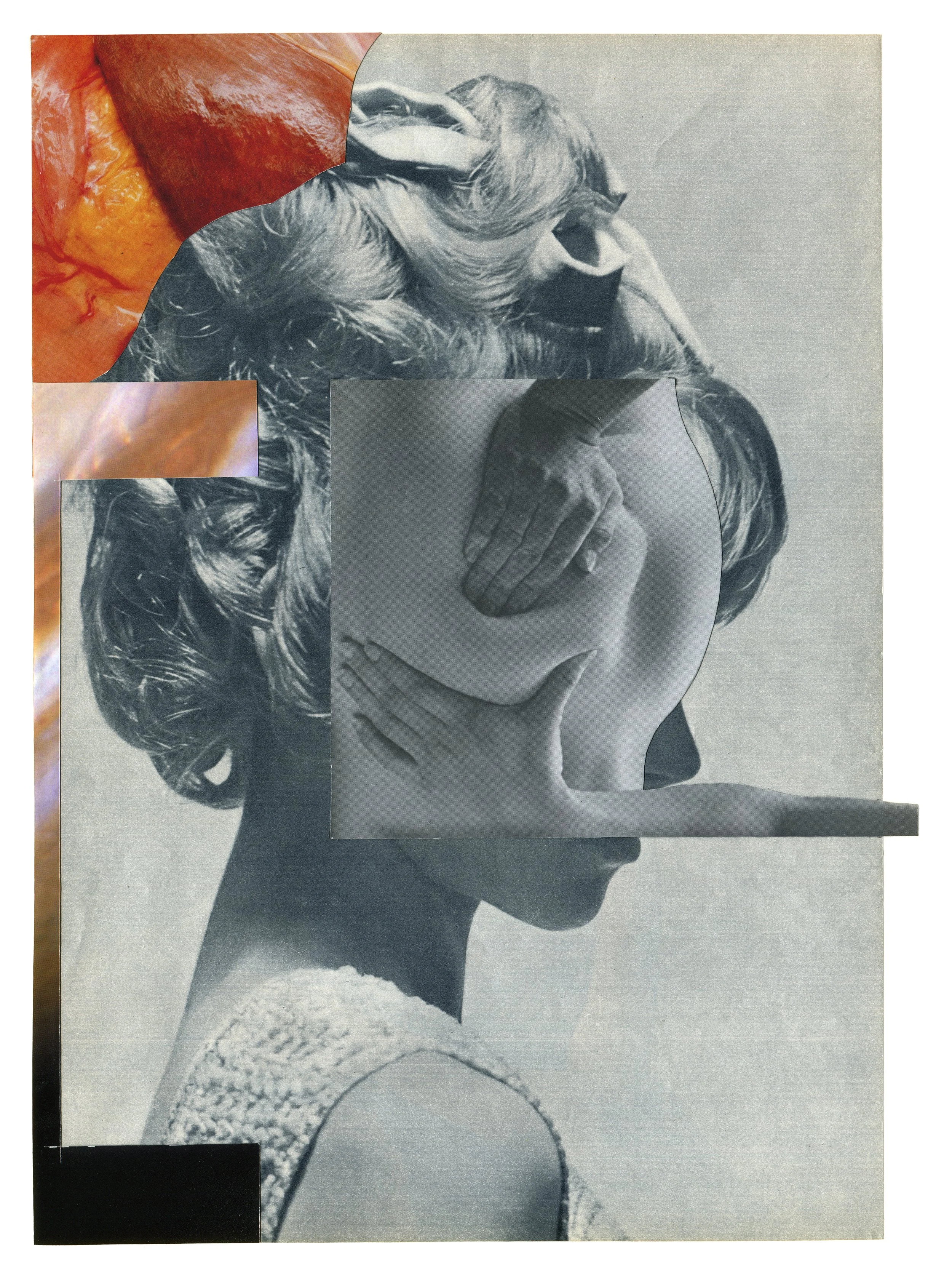
The first book I took apart fifteen years ago was rare and rather expensive. It was a violent gesture. But now the biggest decision for me is in cutting or tearing the pages. Some volumes don’t tear well so I have to cut them. It’s almost medical, I use a scalpel, like performing a surgery on a dissection table. I don’t have any scruples anymore, it’s part of the process.
Do you have a mindset shift when you’re working on smaller collages versus bigger pieces? Is there a different focus?
The large installations are more conceptual in their production. It’s very cerebral, each decision has an impact on the overall result. The process of making a collage is more intuitive and playful. I practise both differently, with a different mindset. If I’m doing too much of one, I’m missing the other. It’s nice to be able to switch between the two. The installations are lengthy projects that take a year or so, they’re exhausting. With collage, it’s like fixing daydreaming associations, it’s a permanent activity and I always travel with a few pages, bits and scissors, even on holiday!
Do you ever reach the end of a piece and feel an element of surprise at the result, after losing yourself in the process of making it?
Yes, and they’re the best pieces! It’s like the dreams in my diary. Some people think I invent those texts yet I could never imagine such a strange narration in a conscious state of mind (or I might have to use strong psychedelic drugs).
It’s the same with the collages. You have an intention in the beginning but the good works take you by surprise – what’s happening in front of your eyes is just something you’d never have been able to plan or conceive. That is the moment of the biggest joy – something happens and you’re just watching it. Sometimes it’s the simplest pieces that are the nicest and I try never ever to repeat a composition. Each collage has its own logic, based on the material I use.
Do you ever work in series’ with your smaller works or does each piece stand alone?
Well, series often happen because I use several backgrounds coming from the same book. You could call it a series, but there is no plan or strategy there. For example, if I find a good album on macro photography, I will use it in maybe five pieces, which would be related somehow.
But I cut books on carnivorous plants, felines, fighting dogs, circus, art history or medical science, and backgrounds and clips may spend many years in my studio before being used. So, at the end, all series mix up in a big chaos. I would usually not exhibit a group of similar works together but instead show different associations. Even if, in an ironical gesture, as I won the women’s art price in honour of Marianne Werefkin, I went into my catalogue raisonné and selected collages with all kinds of cats.
I see myself as a feminist, but I’ve been fighting to make art and be accepted as an artist for the last thirty years, not just a female artist. I made a gentle provocation challenging the art system: is there a production specific to women? If so, will they do furry cats, pink dresses and cherry cakes? And why are kitties so successful on social media? I decided to twist the situation and irritate the visitors by offering them the art they could expect from a girl or on Instagram — and luckily most of them got the ironical gesture and smiled at the show.


When you look at the collages in your archives do you see changes within yourself, like a progression in style or approach?
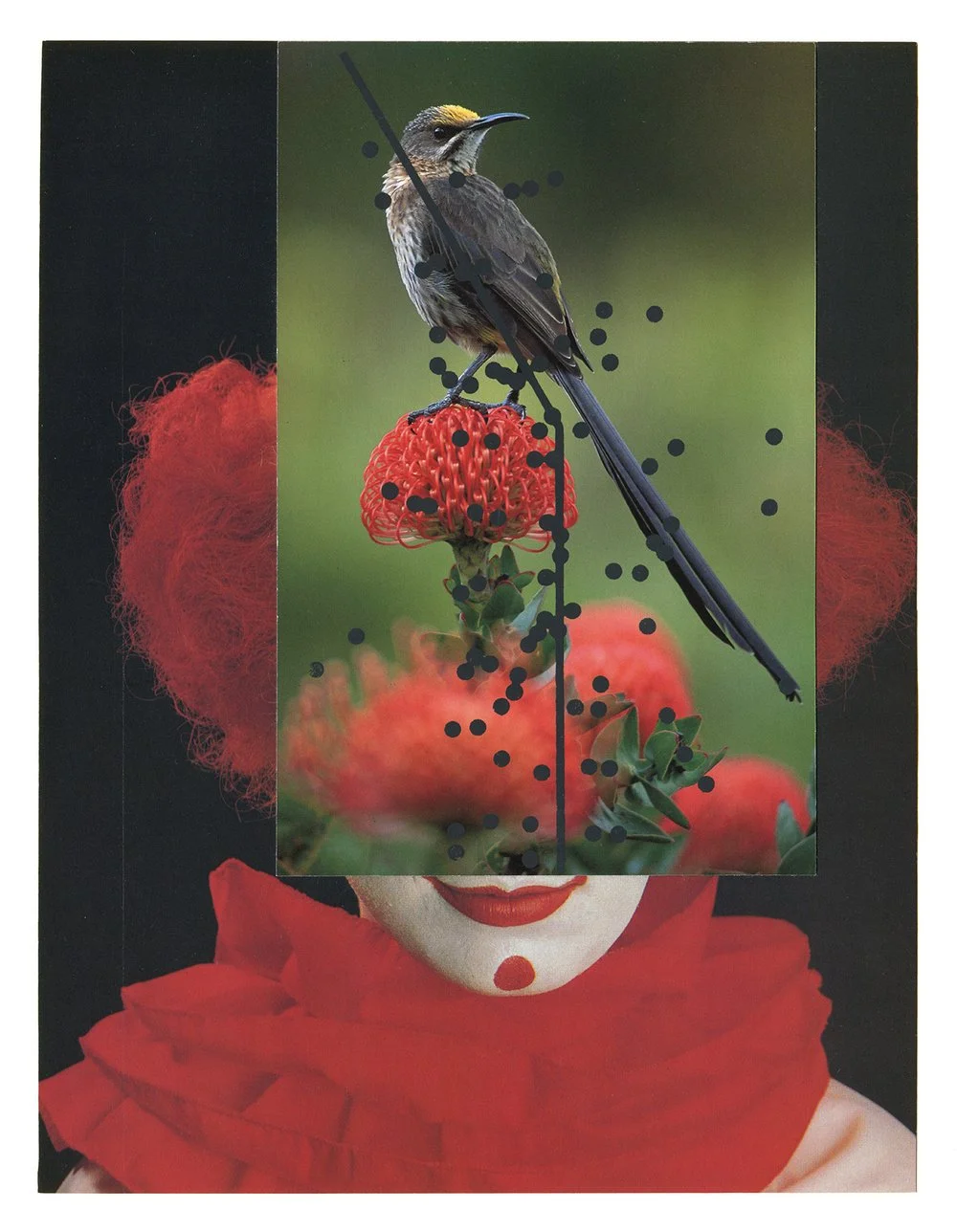
Sure, but also, similar things are popping up again and again, like the use of dots
and circular holes. There will be periods of mostly black and white compositions, followed by explosions of colour, then back to B&W. I let my mood (and the books I cut) speak.

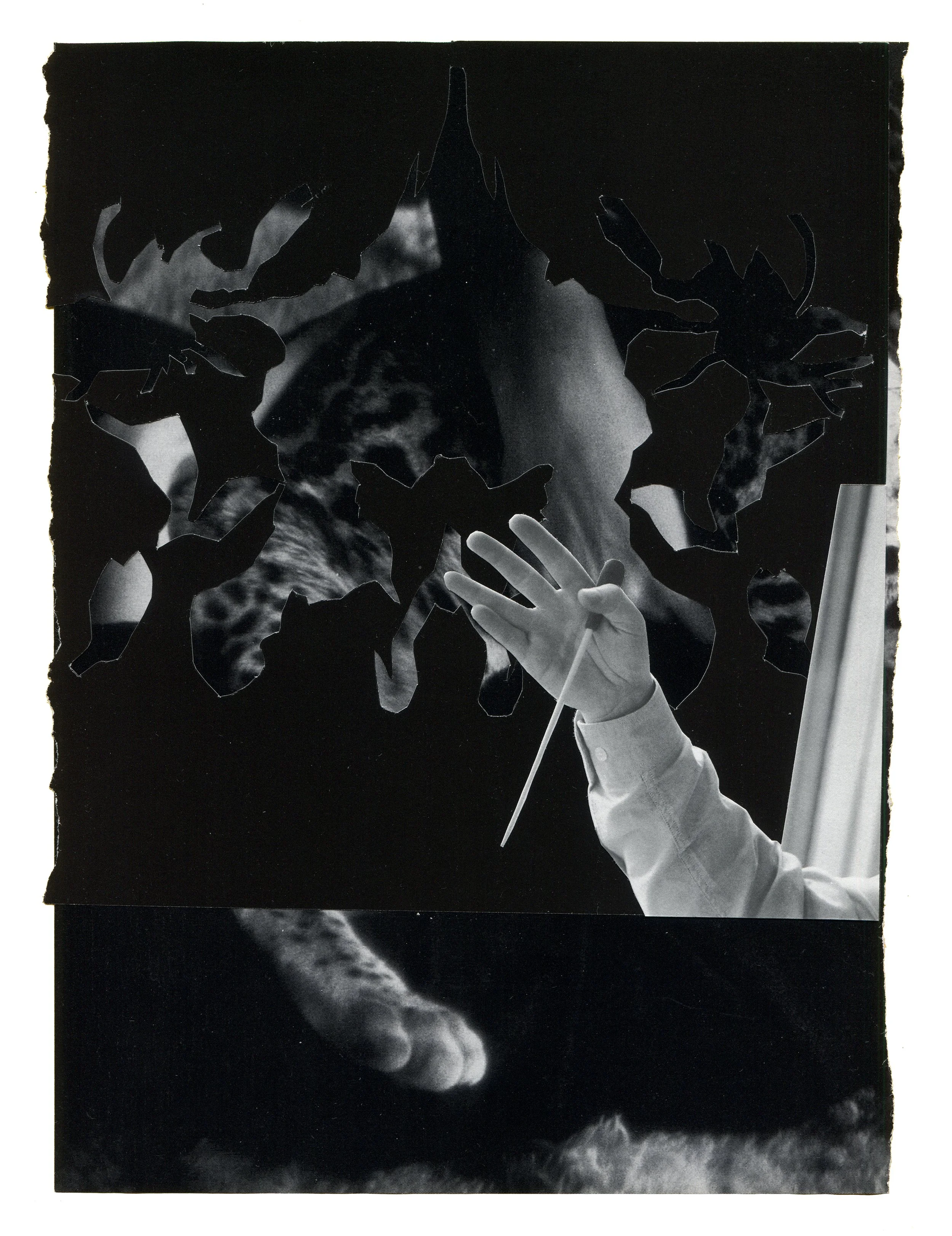
“I never give titles to my collages, hoping not to force any interpretation on the viewer. My works derive their raison d’être from the uncanny and often subversive associations that occur in the making. They are dissonant, contradictory, but also imploded, frail and splintered. The most compelling compositions almost take me by surprise. It’s as if someone else had made them. In this collage from 2016 the flip sides of the cut-out motifs were the most interesting parts and created shapes that I couldn’t even invent or conceive. An attentive viewer will be able to generate their own narrative out of the motifs and their connections.”
You could almost look at it like a visual diary in some way.
Absolutely. There is definitely a connection between the last piece and the next which mirrors my obsessions at a given moment in my life.
As someone who has worked a lot with galleries, what’s your view on collage as a medium in terms of its standing within the art world? Do you think it’s seen as a lesser medium than painting?
When I started making collages, the medium was seen as rather outmoded, a reminiscence from the surrealist times. But in the last few years it has become trendy – as it’s a rather cheap and direct way of creating art. You don’t need a big studio or a large investment to make collages. It’s also interesting to see the variety of artists and the diversity of their production, the material they use as sources, from analogue to digital, from figuration to abstraction, from fashion magazines to war imagery.
I recently sold a few pieces to the Berlinische Galerie Museum, they opened the drawer and they put my work next to some by Hannah Höch. It was one of the happiest moments of my life! I was like, holy shit, I’m in the same drawer as this great artist! This drew the line connecting Hannah Höch, George Grosz and Max Ernst to the collage artists of today. Still, let’s be honest, the art market prefers painting to works on paper – oil on canvas is supposed to be long-lasting, easy to store and a good investment that will end up in auction houses.
Do you sell your small pieces? How does that make you feel?
Oh, it makes me happy, especially if I meet the buyer. I’m always curious about what people choose, what they see in the artwork. It’s a very personal thing. I have one collector in Paris who told me recently that she passes in front of her piece daily in her entrance corridor and that each time it tells her something else. This is what collage has to do. The viewers finalise the artwork by allowing their associations to run wild.
I speak to some collage artists who are often torn between selling their work to make income but at the time feeling like they really don’t want to let it go?
It’s true, but I’m elated to let it go, actually. I’m much happier that it lives with somebody else than it rests in a box in the studio. Let them out, that’s what I say...set them free!
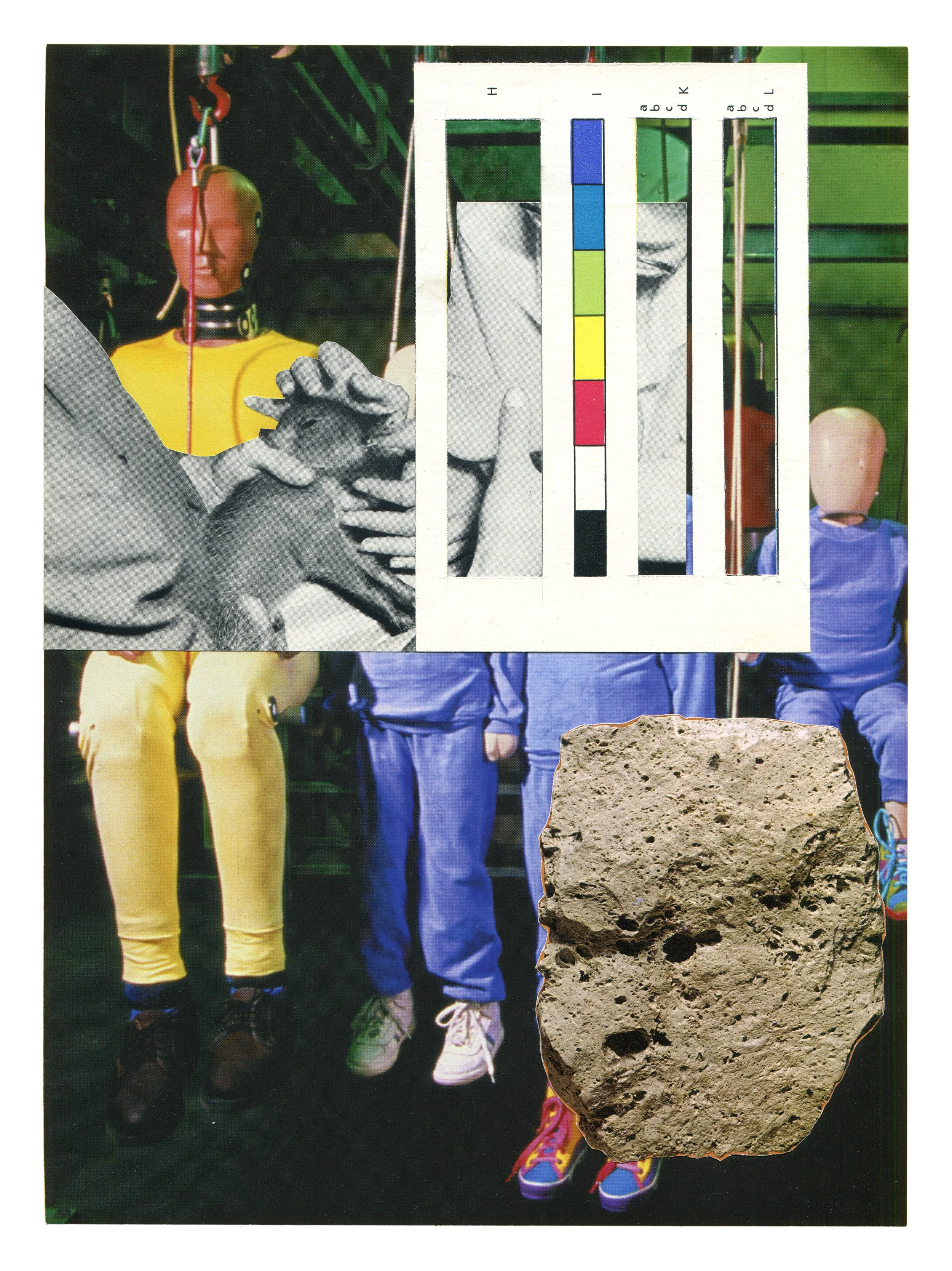
So, what’s in the future for you? You’ve got your next big installation underway, I hear...
Yes, at the moment, I’m preparing an exhibition called Inner Worlds, which deals with the heritage of Sigmund Freud in the art of the 20th and 21st centuries and will open in Tübingen in October. It will include historical pieces from the surrealists but also Francesca Woodman and Cindy Sherman.
I’m really honoured to be included in the show. For this occasion, the curator asked me to produce a new collage on an eleven metre wide wall. A follow-up from my projects at CPIF in France and Haus am Kleistpark in Berlin. It’s super exciting. I have a 1 to 10 reduction of the wall in my studio. I manipulate fragments and shapes every day. They will include Tracht, bikinis, carnivorous plants, cabbage and pink bars evoking sex toys!
That brings up some logistical issues. How do you put that together and hang it?
Yes. For me it’s important that they’re real collages and not a simple wallpaper being printed out and glued to the wall. It’s not an enlargement of an existing composition, it’s an artwork in itself with its own scale which will disappear once the exhibition is over.
Does working on such a large scale ever faze you. A lot of artists would look at a wall like that and feel a bit intimidated. You’re used to working on quite a large scale.
Because of my background in sculpture and installation, I guess I am used to working with different sizes and dimensions. I like producing in S, M, L, XL, XXL, XXXL, whatever!
You can see more of Barbara’s work on her website: barbara-breitenfellner.de
and on her Instagram account: @barbarabreitenfellner